





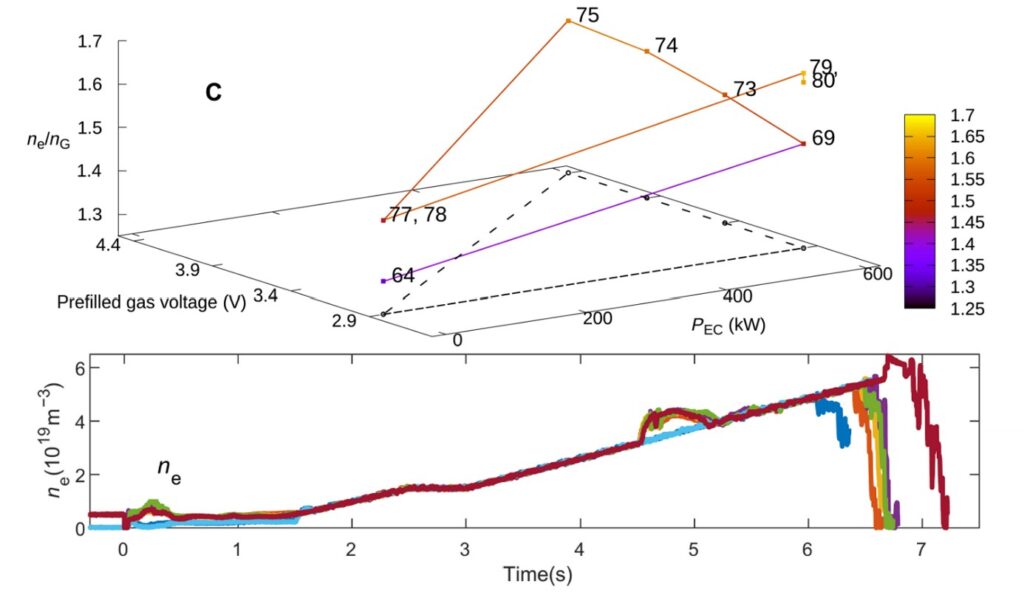
Successive EAST experiments show a virtuous cycle: as Electron Cyclotron Resonance Heating (ECRH) power and pre-filled gas are optimized during start-up, plasma impurities (B, effective charge Zeff) decrease, allowing the achievable density limit (C, normalized to Greenwald limit ne/nG) to rise significantly, breaking a long-standing barrier. Credit: Science Advances.
Researchers at China’s Experimental Advanced Superconducting Tokamak (EAST) have smashed a fundamental barrier in magnetic confinement fusion, experimentally proving a new regime where plasma density is no longer strictly limited by long-established laws. The breakthrough, published in Science Advances, provides a practical new approach for achieving the high-density plasmas essential for fusion ignition.
For decades, tokamak operation has been constrained by the Greenwald density limit, an empirical ceiling beyond which the plasma becomes unstable and collapses in a disruptive termination. Since fusion power scales with the square of the plasma density, this limit has been a major roadblock on the path to commercially viable fusion energy.
The EAST team, co-led by Prof. Zhu Ping and Associate Prof. Yan Ning, has now experimentally accessed a predicted “density-free” regime by carefully controlling the earliest moments of the plasma’s life. By injecting a higher-than-usual amount of deuterium gas and using Electron Cyclotron Resonance Heating (ECRH) during the plasma start-up phase, they fundamentally altered the plasma-wall interaction dynamics.
This novel start-up technique significantly reduced impurity generation and radiation losses, allowing the plasma to reach line-averaged densities of 1.3 to 1.65 times the Greenwald limit—far exceeding EAST’s typical operational range. Crucially, these high-density plasmas remained stable.
The results provide strong experimental validation for the Plasma-Wall Self-Organization (PWSO) theory, which predicted the existence of this high-density, stable regime. The theory describes a feedback loop between the plasma and the reactor wall (made of tungsten in EAST), where lowering the plasma temperature at the divertor target plates weakens impurity sputtering and allows density to climb without triggering a disruption.
“The findings suggest a practical and scalable pathway for extending density limits in tokamaks and next-generation burning plasma fusion devices,” said Prof. Zhu.
The team now plans to apply this innovative start-up method during high-confinement (H-mode) operations on EAST, aiming to combine high density with the high performance needed for a future fusion reactor.
Significance: This work demonstrates that a fundamental performance limit in tokamaks is not an absolute wall, but a barrier that can be bypassed through clever control of plasma physics from the very first moment. It offers a new, theoretically grounded strategy for achieving the high-density plasmas required to meet the Lawson criterion for energy breakeven, bringing the dream of fusion energy a significant step closer to reality.
Check the original Science Advances article by Jiaxing Liu et al. at: https://www.science.org/doi/10.1126/sciadv.adz3040